Data Engineering And security
winter school
winter school
Project contest results
| Projects | Place |
|---|---|
| Fiducia | 1st place |
| Unison | 1st place |
| PetMap | 1st place |
| AI-Driven | 2nd place |
| Traveler of Battle | 2nd place |
| PureTerra | 2nd place |
| The Last Train | 3rd place |
| SMAM | 3rd place |
| Semantic Immersion | 3rd place |
| Smart Email Advisor | 3rd place |
| iStudio | 3rd place |
| Karaoke Stars | 3rd place |
| Loomi | 3rd place |
| Базис | 3rd place |
| EquipWise | 3rd place |
| MetricMind | 3rd place |
| ReMech | 3rd place |
| Choose Path | 3rd place |
| Fitness Data Detective | 3rd place |
| Dog Breeder Web Platform | 3rd place |
| Trends AI | 3rd place |
| NorMap | 3rd place |
| DRUZI | 3rd place |
| Infofront UA | 3rd place |
| Admin Control Hub | 3rd place |
| ExplaAI | 3rd place |
| MindGuard | 3rd place |
| Controversia | 3rd place |
| Libris | 3rd place |
| Loop | 3rd place |
| TryBeforeBuy | 3rd place |
| Свій до свого | 3rd place |
| PayPlay | 3rd place |
| Re:Motion | 3rd place |
| Plat Up: Light & Dark | 3rd place |
| logicRent | 3rd place |
| ToDo Manager | 3rd place |
| Bun on the Run | 3rd place |
| TechIndustry | 3rd place |
| RecipeShelf | 3rd place |
| DreamDiary | 3rd place |
| Wear&Where | 3rd place |
| Planner with Energy | 3rd place |
| SafeHub | 3rd place |
| AlertShield | 3rd place |
| English Side: Learn English | 3rd place |
School participants have the opportunity to receive a certificate.
About the School
DES is not just an IT school but a true center of innovation at the Ivan Franko National University of Lviv. Every year, all interested students from all over Ukraine gather here to gain new knowledge from leading IT experts. DES offers an opportunity to delve into the world of up-to-date technology, unlock your potential, and receive skills that open doors to exciting projects and career heights.
Our objective is to introduce as many young people as possible to the perspectives and new opportunities in the IT industry. Thanks to accessible and high-quality information, our students, with the help of specialists from famous IT companies, can not only gain knowledge but also reinforce it through practice.
School topics: Soft Skills, Software development, Mobile development, Web development, High-performance computing, Databases & Data warehouses, Cloud services and technologies, Cloud computing, Big Data, Data analysis & data processing, Machine Learning & Deep Learning, Machine Learning toolchain, Advanced Мachine learning, Generative AI, Large Language Models, RAG Systems, Real-world AI applications, AI agents, Application of AI in cyber security and data processing, Virtual reality, Metaverse, Digital twins, Artificial Intelligence of Things, Autonomous Systems, Cyber Security.
During such difficult times for the country, the support and development of such projects is a direct contribution to the intellectual potential of the young generation and, consequently, to the technical development of Ukraine.
The school curriculum focuses on the in-depth study of core innovative educational programs:




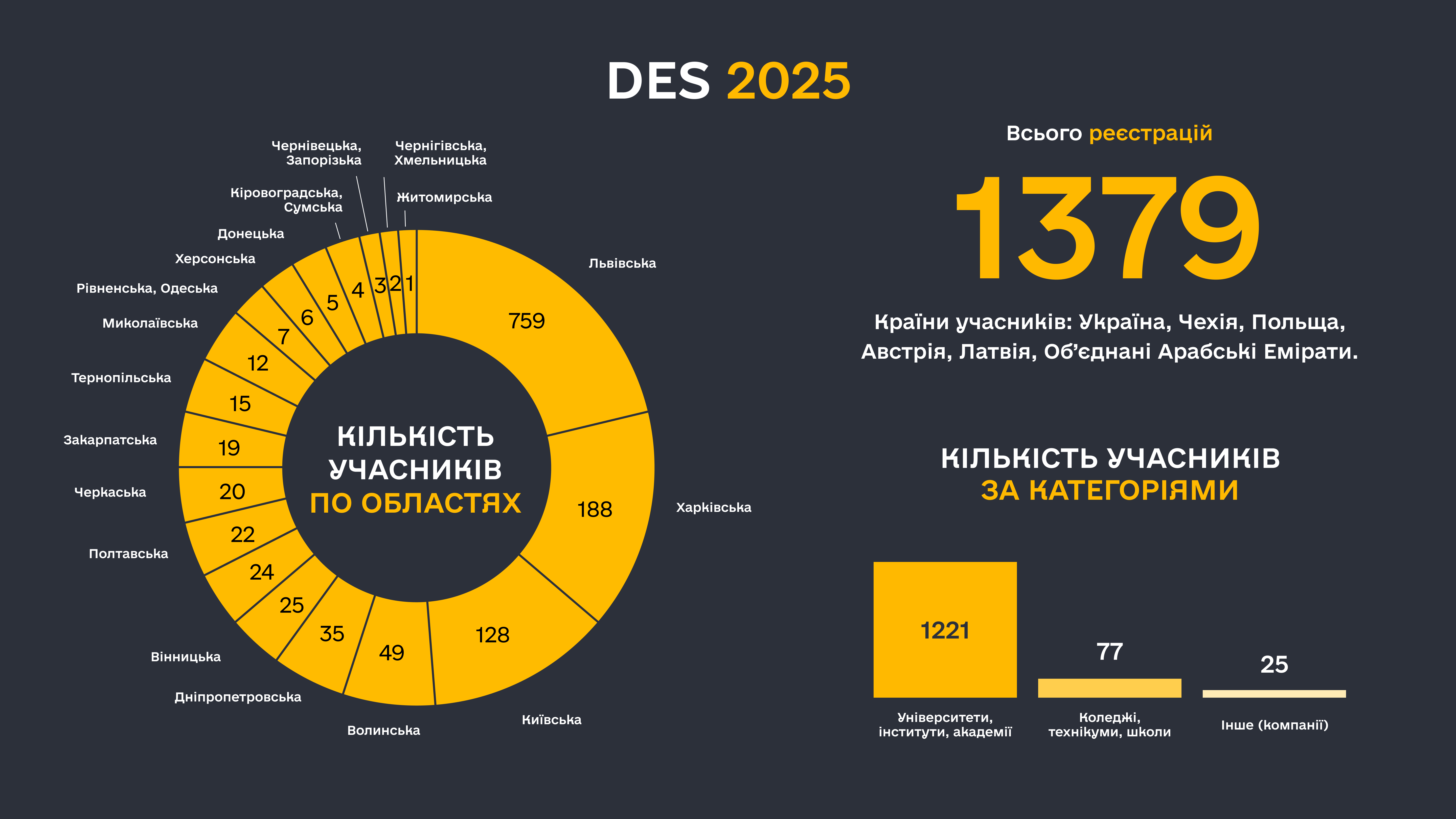
Experience DES 2020-2025

Map of Last Year’s Participants

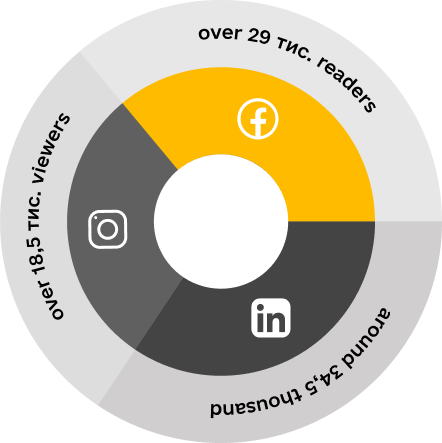
Audience for disseminating information about DES and its partners
join_us2026
Duration: January 19 - January 30, 2026
Format: Online/exclusive live meetings are possible
.Learning features: Three parallel educational streams (Core A - 1-2 year students; Core B - participants with experience in IT, including 3-4 year students); Core C - students with no experience in IT.Б.
School language: Ukrainian/English
Target audience: Students of engineering specialties in Ukraine and abroad.
"The future belongs to those who are able not only to adapt to changes but also to determine their direction," Tim Berners-Lee, inventor of the World Wide Web.
School Topics
Soft Skills
- Communication
- Collaboration and teamwork
- Time management and organization
- Empathy / Emotional intelligence
- Owning up to errors
- Problem solving and creativity
- People skills and management
- Innovation
- Analytical thinking
Software Development
- C, C++, Java, Go, Python
- Digital Immune System
- Superapps
- Platform Engineering
- Software and System architecture principles
- Decentralized applications, Web3
- Version Control Systems: Git, Data Version Control (DVC), etc.
Mobile Development
- Native development for Android and iOS
- Cross-platform development using Flutter, Qt
- Kotlin Multiplatform for Cross-Platform Mobile Development
- React Native for mobile
- Integration of artificial intelligence systems in mobile development
- Distribution of mobile applications
Web Development
- Web development using Flask / Django, React.js, etc.
- Authentication methods for web services
- Organization of infrastructure and deployment of web services
- Web analytics, Social network analysis, Crawlers, analytical platforms
- Integration of artificial intelligence systems in web development
- JavaScript
- SaaS, PaaS, and IaaS
High-Performance Computing
- Fundamentals of parallel, hybrid and distributed computing
- GPGPU, CUDA, OpenCL
- Getting Started with Jetson Developer Kits (Xavier NX, AGX Orin, Orin Nano Super, AGX Thor)
- Getting started with Google Coral's TPU USB Accelerator or/and Google Coral Development Board
Databases & Data Warehouses
- Relational, non-relational, distributed databases
- Data warehouse, ETL, Data Workflows
- NoSQL: Key-Value, Column-based, Document-based, Graph databases
- Database usage for Data Science, Data Analysis and Machine Learning
Cloud Services and Technologies
- Amazon Web Services
- Google Cloud Platform
- MS Azure
Big Data
- Big data frameworks: Spark, kafka, hadoop, databricks
- Big Data in AWS
- Big Data in GCP
- Big Data in Azure
- Big Data Visualization
Data Analysis & Data Processing
- Data analysis, Data analytics, Statistical data analysis, Predictive Analytics
- Business analytics, Web analytics, Biostatistics, Time Series Analysis
- Crawlers
- Optimization tasks
- Recommender systems
- Data processing and data visualization
- Data mining: RapidMiner, Weka
- Analytics platform: Microsoft Power BI, Tableau, SAP Analytics
Machine & Deep Learning
- Machine and deep learning, Neural networks
- Supervised Learning
- Reinforcement Learning
- Unsupervised Learning
- Data sources (Kaggle, etc.)
- ML Hubs (Hugging Face, etc.)
- CV, Image recognition and classification
- NLP, Speech recognition, Audio recognition, Text recognition
- Emotion detection, Pose detection
- Deep learning for forecasting
Machine Learning Toolchain
- Basic libraries: Numpy, Pandas, Scikit-learn, Seaborn, matplotlib, sktime, skforecast
- TensorFlow, Keras, PyTorch, Apache MXNet
- CV Libraries and frameworks, OpenCV
- NLP libraries and frameworks, NLTK
- OpenAI Gym, Apache Airflow
Advanced Machine Learning
- Management systems of artificial intelligence
- Intelligent applications
- Enhanced intelligence WIPO Technology
- End-to-end Machine learning projects/models to solve practical problems
- Transfer learning
- Genetic Algorithms (GAs) in Machine Learning
- Adaptive AI
- AI Trust, Risk and Security Management (AI TRiSM)
- AutoML
- Multi-modal learning
- Democratized AI
Generative AI
- Generative models, text and speech generation, artificial art
- Diffusion models for image and video generation
- LLM, Transformers, BERT, GPT models family (GPT-1, 2, 3, 3.5, 4)
- LLM fine-tuning techniques
- ChatGPT usage, ChatGPT API, tokenization, creation and usage GPTs
- Opportunities of generative models
- Generative AI in the hands of hackers: what are the risks
- AI Code Generation, Copilot, etc.
- RAG systems, SELF-RAG, Self-Correcting and Self-Improving RAG systems
- Generated code issues
- Chat bots (СhatGPT, etc.)
Real-world AI Applications
- Usage of AI in modern services, applications, platforms
- Building of products empowered by AI
- Application of AI in cyber security and data processing
- AI in COVID research and solutions
- AI in sustainable, ecological and environmental technologies
- Decision Support Systems and Applied Observability
- AI in Automotive
- Atomization AI
- Virtual reality, Metaverse, Digital twins
- AI agents
Artificial Intelligence of Things
- Internet of Things (IoT), Industrial Internet of Things (IIoT)
- Artificial Intelligence of Things (AIoT)
- Embedded systems. Edge computing
- Edge AI, Embedded AI, Hailo AI
- Autonomous Systems (drones, vehicles, etc), autopilots
Cyber Security
- New types of attacks, analysis and protection
- Types of vulnerabilities and how to deal with them
- How to properly build a defense
- New tactics and strategy selection in SOC creating
- Engineering and Management of SOC Technologies
- Security Information and Event Management (SIEM) systems
- Intrusion Detection Systems/Intrusion Prevention Systems (IDS/IPS)
- Firewalls (FW)
- Endpoint Detection and Response (EDR) systems
- User and Entity Behavior Analytics (UEBA) tools
- Malware analysis systems and sandbox environments
- Artificial intelligence and machine learning for anomaly detection
- Anti-phishing and anti-malware
- Cryptology and encryption
- Information security management
- Security of computer networks and the Internet
- Privacy and protection of personal data
- Organizational and legal issues of information security
- Teamwork and presentation skills
- The latest approaches to the training of cyber security specialists
- Quantum cryptography
- Biometric authentication and multi-factor protection
- IoT device security
- Zero Trust Architecture
Organizing committee